Can Migsun Delta Street Benefit from Greater Noida’s Expanding Lifestyle Economy?
The commercial real estate market across NCR is undergoing a noticeable transformation. A few years ago, most investment discussions revolved around prime locations, launch offers, and future infrastructure announcements. While those factors still influence buyer decisions, the market has gradually shifted toward a more practical and sustainability-driven approach.
Today, investors and end users are paying closer attention to how a commercial project fits within the surrounding ecosystem. Residential density, accessibility, consumer movement, social infrastructure, and lifestyle engagement are becoming equally important factors in evaluating long-term commercial viability.
This broader shift is especially visible in Greater Noida, where planned sectors, growing residential communities, educational institutions, and improving connectivity are helping shape a stronger urban lifestyle economy.
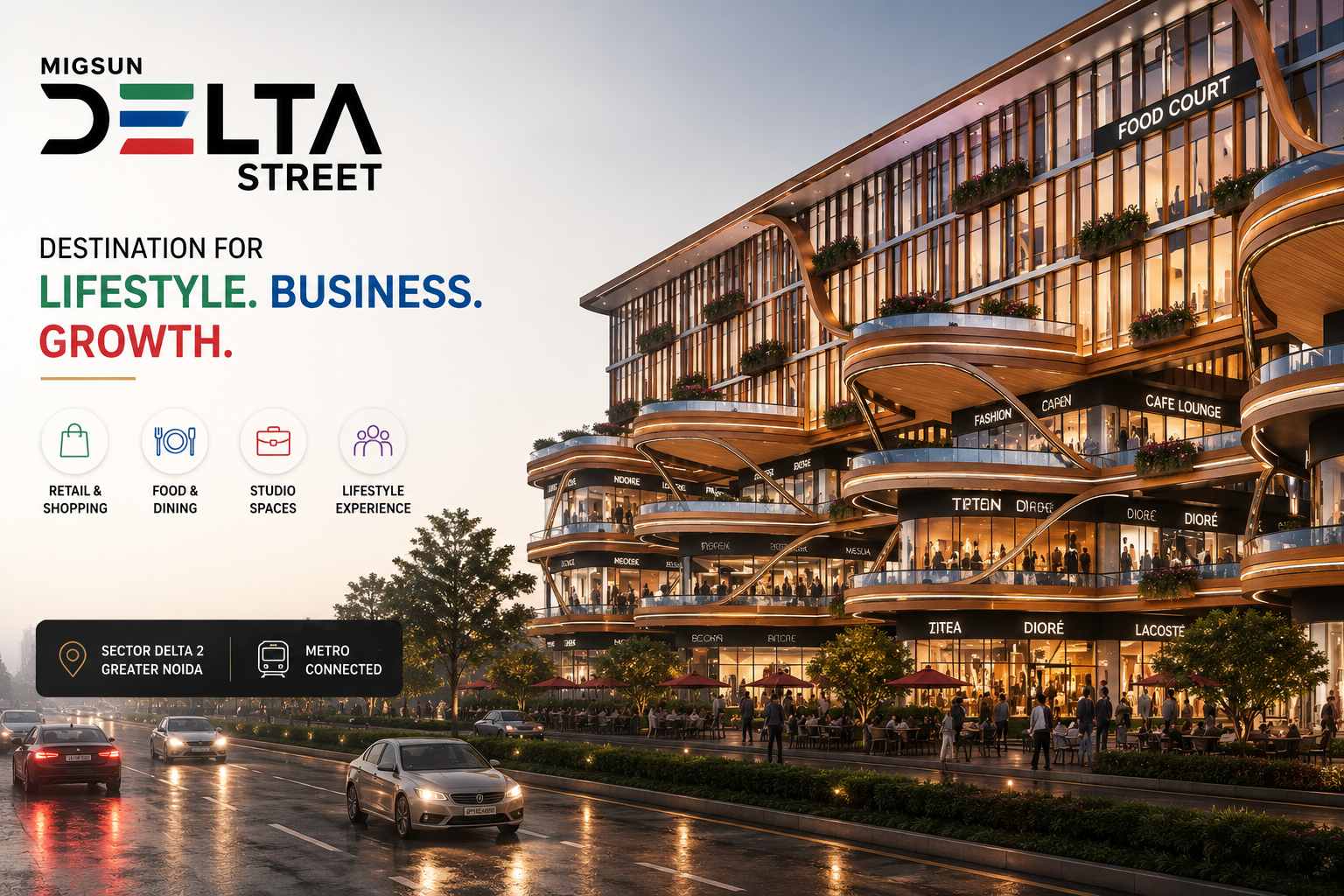
As the city continues evolving, projects like Migsun Delta Street Greater Noida are entering the conversation as part of this changing commercial landscape.
Rather than being viewed only as standalone developments, modern commercial projects are increasingly being analyzed through the lens of urban behavior, consumer patterns, and long-term sustainability.
The Shift Toward Lifestyle-Oriented Commercial Spaces
Consumer expectations have changed significantly over the past decade.
People no longer visit commercial destinations only for shopping. Modern urban consumers prefer spaces that combine multiple experiences within a single environment. Dining, leisure, entertainment, convenience, social interaction, and flexible work culture are now influencing how commercial projects are designed and perceived.
This transition has encouraged developers to move beyond traditional retail formats.
Across NCR, high-street commercial spaces and mixed-use ecosystems are becoming more relevant because they align better with modern urban lifestyles. Instead of functioning as isolated marketplaces, these projects attempt to create environments where people can spend time comfortably.
This trend is also influencing demand for commercial studio formats.
The growing popularity of compact business spaces, flexible commercial setups, and integrated retail environments has created interest in projects that combine retail, work, dining, and lifestyle activity within one ecosystem.
In this context, Migsun Delta Street commercial studio apartments reflect a broader market trend where commercial developments are evolving beyond conventional retail-only structures.
Greater Noida’s Expanding Urban Lifestyle Economy
Greater Noida has steadily emerged as one of NCR’s more structured urban regions.
Unlike older urban pockets where development often expanded in an unorganized manner, Greater Noida benefits from planned sectors, wider roads, institutional infrastructure, and comparatively organized urban planning.
Over the years, the region has witnessed growth across multiple segments:
- Residential development
- Educational institutions
- Hospitality infrastructure
- Office movement
- Metro connectivity
- Retail and food culture
- Daily-use commercial ecosystems
As more residential sectors become active and populated, the surrounding lifestyle economy also expands naturally.
This growth creates demand for:
- Cafes and dining spaces
- Entertainment-driven retail
- Flexible commercial spaces
- Community-focused environments
- Convenience-oriented businesses
The commercial real estate market generally performs more sustainably when supported by active end-user movement rather than purely speculative investment demand.
This is where catchment strength becomes highly important.
Why Catchment Strength Matters in Commercial Real Estate
In modern commercial real estate, location alone is no longer enough.
A project may be situated on a major road or within a recognized corridor, but without surrounding consumer activity, long-term commercial sustainability can become difficult.
On the other hand, commercial spaces positioned within growing residential ecosystems often have stronger opportunities to generate recurring footfall.
This is why developers and investors are increasingly evaluating factors such as:
- Population density
- Residential occupancy
- Consumer movement
- Accessibility
- Social infrastructure
- Lifestyle demand
- Daily convenience patterns
In planned urban environments like Greater Noida, these factors become even more relevant because multiple sectors are expanding simultaneously.
As occupancy levels improve across residential developments, commercial activity also tends to strengthen gradually.
Projects connected to this urban expansion may benefit from long-term ecosystem growth rather than depending only on launch-phase visibility.
Understanding the Relevance of Sector Delta 2
Sector Delta 2 forms part of a larger urban network that benefits from residential presence, institutional activity, and improving accessibility.
The location is positioned within an environment where neighborhood-driven movement can contribute to commercial activity over time.
Accessibility also plays a major role in commercial relevance.
Modern consumers prefer spaces that are easy to reach and naturally connected to their daily routines. Areas supported by road connectivity, metro access, and surrounding residential sectors generally have stronger long-term commercial potential.
As Greater Noida’s urban ecosystem continues evolving, sectors with balanced residential and commercial interaction may gradually emerge as stronger lifestyle-oriented zones.
Within this broader environment, projects like Migsun Delta Street Studio spaces and integrated commercial formats attempt to align with changing consumer behavior and evolving urban patterns.
The Growing Demand for Experience-Led Commercial Spaces
One of the biggest shifts happening in commercial real estate is the rise of experience-driven environments.
Consumers today are increasingly drawn toward destinations that combine multiple forms of engagement.
People prefer spaces where they can:
- Dine and socialize
- Spend leisure time
- Explore retail experiences
- Access convenience services
- Work flexibly
- Combine multiple activities within one visit
This shift has significantly influenced how newer commercial projects are conceptualized.
Instead of focusing entirely on retail units, developers are now integrating food courts, social spaces, entertainment zones, wellness concepts, and flexible commercial formats into larger mixed-use ecosystems.
The rising demand for organized dining spaces is one example of this transition.
Across NCR, food and beverage segments have become major footfall drivers for commercial destinations. Well-designed dining ecosystems often help increase visitor retention and repeat engagement.
This is why concepts like the Migsun Delta Street Food Court become relevant within modern commercial planning discussions.
Food-oriented commercial spaces are no longer viewed simply as supporting amenities. In many urban projects, they function as primary attraction points that contribute to overall ecosystem activity.
Commercial Studio Formats and Changing Work Patterns
Another important change influencing commercial real estate is the evolution of work culture.
Hybrid work models, startup ecosystems, digital businesses, and flexible professional operations have increased interest in compact commercial formats.
Businesses today often prefer efficient, strategically positioned spaces that offer accessibility and integrated commercial surroundings.
This has contributed to growing attention toward commercial studio concepts.
In emerging urban regions, studio-style commercial spaces may appeal to:
- Small business operators
- Creative professionals
- Consultants
- Startups
- Flexible workspace users
- Investor-driven rental models
The relevance of Migsun Delta Street commercial studio apartments can also be viewed within this broader market transition where flexibility and integrated commercial ecosystems are becoming increasingly important.
The Importance of Sustainable Footfall
One of the most overlooked aspects of commercial real estate is the difference between temporary attention and sustainable footfall.
Marketing campaigns and launch excitement may generate short-term visibility, but long-term commercial performance usually depends on recurring user activity.
Sustainable footfall is generally influenced by:
- Residential catchment
- Repeat visitors
- Accessibility
- Tenant mix
- Dining and lifestyle activity
- Convenience-driven movement
- Urban integration
Commercial projects that become part of people’s daily or weekly routines often perform more steadily over longer periods.
This is one reason why modern commercial planning increasingly focuses on lifestyle ecosystems instead of isolated transactional spaces.
Greater Noida’s Long-Term Commercial Outlook
Greater Noida’s commercial story is closely connected to its larger urban development structure.
The city continues attracting residential growth because of its planned sectors, infrastructure expansion, institutional presence, and improving connectivity.
As residential occupancy strengthens, local economic activity also tends to expand naturally.
This creates opportunities for organized commercial environments that support:
- Retail activity
- Food and dining culture
- Service-based businesses
- Community-oriented spaces
- Flexible commercial formats
At the same time, commercial real estate generally evolves over longer cycles compared to residential projects.
Long-term performance depends not only on project development but also on ecosystem maturity, occupancy growth, and sustained consumer engagement.
Projects aligned with broader urban behavior and lifestyle demand may have better opportunities to remain commercially relevant in the future.
Conclusion
The commercial real estate landscape in NCR is steadily moving toward a more experience-driven and lifestyle-oriented model.
Consumers today are looking for convenience, engagement, accessibility, and integrated environments rather than standalone retail spaces.
Greater Noida’s expanding urban ecosystem reflects this larger transition. As residential sectors continue growing and consumer activity increases, the demand for organized lifestyle-oriented commercial developments may also strengthen over time.
Within this changing environment, Migsun Delta Street Greater Noida represents part of a broader shift happening across emerging commercial corridors.
Whether discussing Migsun Delta Street Studio spaces, integrated retail ecosystems, or concepts like the Migsun Delta Street Food Court, the larger conversation increasingly revolves around how effectively commercial projects connect with evolving urban lifestyles.
Ultimately, sustainable commercial success is rarely driven by visibility alone.
It is shaped by how naturally a project becomes part of the daily lifestyle patterns, movement behavior, and long-term consumption ecosystem of the surrounding population.

All Categories
Recent Posts
The Rise of Mixed-Use Commercial Destinations in Greater Noida
Retail Shops, Studio Apartments & Food Lane Investment Opportunity